Most SBA borrowers with personal guarantees have more options than they've been told.
7(a) borrowers in default don't know their options. OIC. Installment agreement. Currently not collectible. A negotiated resolution. Before you conclude the worst — find out what's actually possible.



Mon-Fri 8:30 AM–8:30 PM ET · AI intake available 24/7
AI-assisted intake Takes about 3 minutes No forms We schedule your callback
Your business is struggling to make payments.
This is the moment when the most options are still available. Before a loan is accelerated, before the SBA gets involved, before Treasury steps in — your lender may be willing to negotiate terms you can actually meet.
Loan modification. Forbearance. Deferment. Restructured repayment. These are real options that exist at this stage and may not exist later.
The worst thing you can do right now is nothing. The second worst thing is to try to negotiate with the lender directly — without knowing what your financial picture qualifies you for, or what the lender's actual incentives are.
We review your situation, identify what resolution pathway your numbers support, and negotiate on your behalf — with Power of Attorney. You don't speak to the lender again. We do.
You haven't made a payment in 90 or more days.
At 90 days, the timeline accelerates. Your lender has likely notified the SBA. The SBA may have purchased the guaranteed portion of your loan. The process of moving toward Treasury collection has begun — but it is not complete.
This is not too late. It is, however, the stage where the next step you take matters enormously.
This is the stage where people make costly mistakes — paying attorneys who don't understand SBA debt, attempting to negotiate without knowing what Treasury will accept, or doing nothing and waiting for a garnishment notice.
The right move is a professional assessment of your financial picture before anything else. That's the FAR — Financial Account Review — and it tells you definitively what resolution paths are available to you.
If you are personally liable and cannot repay the full balance, the FAR is your entry point. It determines whether you qualify for OIC, an Installment Agreement, or Currently Not Collectible status — before any resolution is proposed to the SBA.
Days Missed → Lender Notifies SBA
The SBA is notified of default. The loan may be purchased from the lender. The SBA assumes control of collection.
SBA Demands Payment or Initiates Workout
The SBA sends a demand letter. If no response, the loan is referred to Treasury's Bureau of Fiscal Service.
Treasury / Bureau of Fiscal Service Takes Over
Wage garnishment. Tax refund seizure. Social Security offset. All without a court order. Private collection agencies may be assigned.
Where you are on this timeline determines what options are still open. Call us. We'll tell you exactly where you stand and what's still possible.
Your loan is in full default. Treasury is involved.
This is the stage most people call us from. They've received a letter from the Bureau of Fiscal Service. Or a private collection agency has called demanding full repayment in three years. Or they discovered a tax refund that never arrived.
This stage feels like the end. It is not.
Treasury collection is aggressive — but it is negotiable. The Bureau of Fiscal Service has hardship programs. Private collection agencies are legally required to present all available options to you. OIC, Installment Agreement, and Currently Not Collectible status are all available for 7(a) borrowers at this stage — if your financial picture qualifies.
We take over with Power of Attorney. You stop receiving calls. We negotiate directly with the SBA, Treasury, Bureau of Fiscal Service, or the assigned collection agency on your behalf.
And if a collection agency is not presenting you with all available hardship options — we file grievances against them. They are not above the law.
SBA Debt Can Be Negotiated,
Modified, Settled, and Resolved.
These are the available resolution pathways for SBA 7(a) borrowers. Which one applies to your situation depends on your financial picture — that's exactly what the Financial Account Review determines.
Offer in Compromise
7(a) Loans OnlyNegotiate the balance down to a lump-sum settlement based on demonstrated financial hardship. Requires a completed FAR to establish eligibility. The most powerful resolution tool for qualified borrowers — and the most complex to execute correctly.
Installment Agreement
Available NowA structured monthly repayment plan negotiated with Treasury or the Bureau of Fiscal Service at a level your finances can actually sustain. Stops garnishment and offset activity while the agreement is in effect.
Currently Not Collectible
Hardship StatusFor borrowers whose financial situation demonstrates true inability to pay. Treasury suspends active collection. This is not forgiveness — but it provides relief while your situation is evaluated.
Loan Modification
Early StageRestructure the loan terms — extended timeline, reduced payments, adjusted interest — before the loan reaches full default. Available at the lender stage when the business is still operating.
Workout / Negotiation
All StagesA direct, hard-nosed negotiation with the SBA, Treasury, or the Bureau of Fiscal Service to reach a structured resolution. We negotiate with Power of Attorney — you stop receiving calls.
Bankruptcy Referral
Last ResortIf no other pathway is viable, we provide a warm referral to trusted bankruptcy counsel. We tell you this before anyone else would. And we only arrive here after exhausting every other option.
Important: OIC (Offer in Compromise) is available for SBA 7(a) loans. It is not available for COVID EIDL loans. If you have an EIDL loan, your resolution pathways are workout, modification, deferment, and hardship resolution. See the EIDL path →
Financial Account Review.
The answer you cannot get anywhere else.
Every competitor in this market offers a free 30-minute call with a consultant. That call is a sales intake. It tells you what services are available — not whether you qualify for them or what outcome is realistic for your specific financial picture.
The Financial Account Review is a professional determination — conducted by our team — of whether your financial situation qualifies you for an Offer in Compromise, an Installment Agreement, or Currently Not Collectible status. It answers the question that matters: what can actually be done for your situation?
- A complete analysis of your income, assets, expenses, and liabilities — the same factors Treasury uses to evaluate hardship
- A definitive determination of your eligibility for OIC, IA, or CNC status on your 7(a) loan
- A clear recommended resolution pathway based on your actual numbers — not a general explanation of what options exist
- If you qualify for OIC — a concrete estimate of what a realistic settlement figure looks like
- If you qualify for IA — a proposed monthly payment structure Treasury is likely to accept
- Direct, honest feedback if none of these pathways applies — and a clear explanation of what does
FAR - Professional Determination
A professional financial determination - conducted by our team - of your eligibility for Offer in Compromise, Installment Agreement, or Currently Not Collectible status.
A professional financial determination - conducted by our team - of your eligibility for Offer in Compromise, Installment Agreement, or Currently Not Collectible status.
One flat fee. Monthly payment plan available. We'll cover exactly what it costs on your strategy call.
- OIC eligibility determination for your 7(a) loan
- Installment Agreement qualification analysis
- Currently Not Collectible status assessment
- Recommended resolution pathway with supporting rationale
- Conducted by our credentialed in-house team — not a consultant
The FAR is the gateway to Tier 3 Resolution. We do not proceed to full negotiation without it — because we don't negotiate without knowing what we're negotiating toward. That's not how you get results. That's how you make promises you can't keep.
They Said: Pay Everything in Three Years — or We Take It All.
That is not your only option.
Private collection agencies are assigned by the Bureau of Fiscal Service to collect defaulted SBA debt. They are trained to create urgency. They demand full repayment within three years. They make it sound like there is no alternative.
There is an alternative. And they are legally required to present it to you.
Private collection agencies must offer borrowers all available hardship programs — not just the most aggressive collection option. If your PCA is not doing that, they are not following the rules. And we file grievances against PCAs who fail to present your full options.
"Private collection agencies are telling borrowers: pay everything in three years or we take it all. That's not your only option."
Do not make payment arrangements directly with a PCA before speaking with us. Once you enter an agreement, your negotiating position changes. A five-minute call gives us what we need to tell you whether what they're offering is your best available option — or just the easiest one for them.
Call 352-505-9151 Before You Agree to AnythingCall Us.
Tell Us What's Going On.

No forms. No intake questionnaires. No waiting for a callback from someone you've never spoken to.
You call. We listen. You describe your loan, where things stand, what you've received. We ask a few questions. Then we tell you what your options are.
That's the call. No pressure. No pitch. You'll speak with someone on this team who has handled hundreds of SBA cases — and who will give you a straight answer about where you stand and what's still available to you.
If your situation calls for a Financial Account Review, we'll explain what that involves and what it costs. No surprises. We do not begin resolution work without a clear agreement on what we're doing and what it will cost.
Your lender was paid.
You still need legal representation.
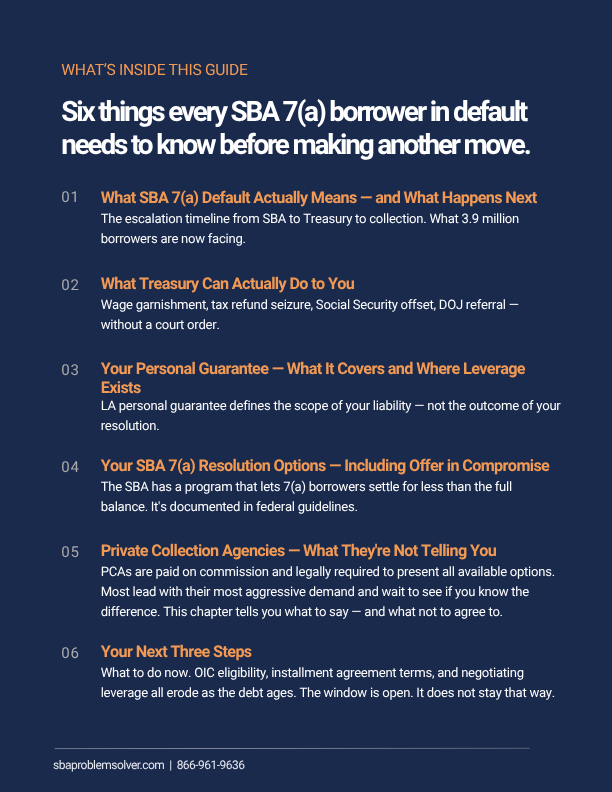
Most SBA 7(a) borrowers in default don't know their rights — or that an attorney can negotiate directly with Treasury on their behalf before collection escalates. This guide explains what that representation looks like and what your options actually are.
You have options. Most people just don't know what they are.
Saturday hours TBD
Use Our Chat!
Know where you stand.
Know what's possible.
Know what to do next.
SBA 7(a) loan default. Personal guarantee. Treasury collection. We've navigated all of it — for hundreds of business owners across the country.